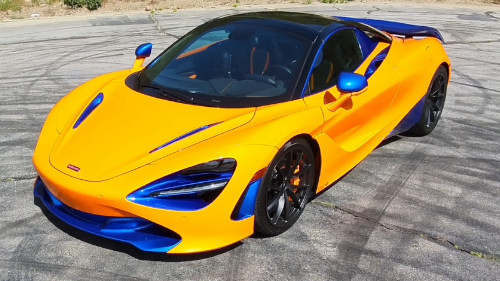
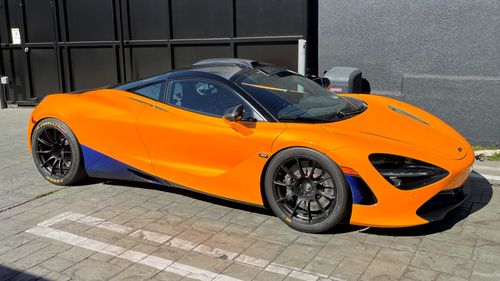
Built to replace my 720s, which burned along with my home and all other uninsured project cars in the 2025 Malibu / Palisades fires. The original car was nicknamed the “Toyota Hilux” because it refused to die after 80,000+ miles on a stock engine tuned to 1000whp, which is ironic for a McLaren (more on the old car at the bottom of this page). The old car did a 1.8s 0-60MPH on street legal toyo tires (prepped drag strip with 1 foot rollout). It also achieved a 1/4-mile time on the same day, in the 8s, on the same tires.
For this new 1,200s Spyder, I wanted to apply all the learnings from the previous car and do only what was necessary to achieve a lap time on Big Willow within a second of the old car, all while keeping this car more comfortable yet just as beautiful. Less handling & weight reduction mods. Plus, this car would be the newer convertible based on the “Spyder” model. The old car (Hilux) was a handful. Lowered with such an aggressive alignment, stagger, and suspension changes, the vehicle would tramline on any road. You would be literally sweating, fighting the wheel on my old car as you drove down the highway. The Hilux was much more of a race car and less of a road car than this newer 1,200S.
This new car is capable of producing a dyno-proven 1,200WHP on a blend of C16 & MS109. The car does not feel “happy” at 1,200WHP. However, this car can deliver around 1,000hp (890whp) all day around Big Willow on VP101 (available at the track) road racing without overheating in 90-degree F ambient weather. This car also features a map for ACN91 (91 octane pump gas), which produces approximately 850whp. This is the map it's driven on most. Critical to all of this is the larger fuel injectors, fuel pump, and upgraded cooling system (intercoolers, etc). For that reason, the car is not often used in its 1,200HP map. On the street and when circuit/road racing, the car is typically in its 1,000hp map where it is happy flat out on track, road racing all day with 90-degree ambient temps.
A 6-point harness with a custom harness bar (McLaren offers no roll bar for the Spyder models) was developed, along with custom color Senna seats & fire suppression so that this car can be FIA-approved.
Last but not least, the car was fitted with the original engine nameplate from the original 720s (Hilux), which somehow survived the rubble.
My old McLaren 720s was nicknamed the Toyota Hilux for its ironic refusal to die (80,000+ miles) up until the end, where it took a literal 100MPH firestorm to kill it. It served as a friend & research car by many (tuners, reviewers, etc...) to test the limits of the (P14 platform). That car was modified over 7 years (2018-2025) and underwent hundreds of test-and-tune days and even some competitive road-racing events. I would also attend at least one circuit racing event per month at Willow Springs (Big Willow) raceway. I did NOT treat that car well. It was also tracked at Watkins Glen, Lime Rock Park, Buttonwillow, and other circuits around the U.S. Over 80,000 miles were logged on that car (many of them at the limit). Aside from Cam Phasers being replaced every 40k miles, that car had no issues (ironic for a McLaren, which is why we named it the Hilux). The oil was changed every few thousand miles, though, and the car was well maintained.
That car also did a 1.8s 0-60MPH on street legal toyo tires (prepped drag strip with 1 foot rollout). It also achieved a 1/4 mile time on the same day in the 8s, both on street tires. More about my old 720s, nicknamed the Toyota Hilux, here. Hard to put into words the bond I had with that car.
The Hilux (my old 720s) was the development car for several tuners in the early days. Everything about that car was dialed to the max, but many sacrifices were made in terms of daily drivability. Much of the interior was removed, and non-structural metal was cut out. The car was so loud inside that you couldn’t have a conversation. A roll bar was added, along with 6-point harnesses, Senna seats, and an alignment so aggressive that you couldn’t even drive on the street without literally sweating fighting the steering wheel to prevent it from tramlining following any cracks in the road. Rolling anti-lag was fitted. Its tires were so wide that all fender liners were pulled, fenders flaired/rolled, to the point that the tire made contact with the carbon tub on multiple occasions on track nearly killing me. Coolant lines were replaced (as they would often leak on a tire and try to kill me on track). Increasing the offset any further led to handling issues. The Essex AP Racing brakes, combined with a lowered suspension and stiffer springs, resulted in a car that would stall at lower idle speeds due to the large injectors and low duty cycle at idle. That car also ran on Pirelli DH Ferrari Challenge slicks and custom, wider forged wheels on track, and Goodyear Eagle Supercar 3Rs on the street (hands down the best street-legal tire once warm for the P14 platform). It was a beast, but more of a race car than a road car, which began to erode the McLaren P14 platform's biggest value proposition: its daily drivability.
Advice for other McLaren owners as someone who had a 720s, which made it to 80,000+ miles, tracked monthly without any issues. I always tell people buying McLarens that the 720S, 756LT, and 750S (P14 platform) generations are the most reliable McLarens ever built. Even then, many of them are lemons as they are hand-built. You won’t be able to tell until you live with it and drive it for a few months if you have a lemon or not. But if you don’t get a lemon, the P14 cars are one of the most reliable on the road. Lighter and more powerful than a GT2RS. The McLaren interconnected hydraulic suspension system, Proactive Chassis Control II (PCC II), is light-years ahead of Porsche's, but that also makes the 720s illegal in many racing categories. Porsche is more focused on racing within the rules.
The other model McLarens (GT, Artura, etc) all have design flaws IMO (sometimes massive). The P14 platform (720s, 750S, 765LT) did not really have any major design issues. Everyone I know who purchased a Senna ended up selling it, though. As it uses a unique (and flawed) suspension with many problems, and the engine has a unique camshaft and some changes that make it much less reliable than the 720s/765/750s.
Tips for other 720/750/765 owners: